Handmade Luxury: Direct from Jaipur Carpet Studios to Your Home

JAIPUR CARPET STUDIO
ASK THE EXPERT
Rug Buying Guide — Luxury Comparison 2026
Persian Rugs vs Indian Rugs: Key Differences Every Buyer Should Know
When comparing Persian rugs vs Indian rugs, the differences go far deeper than geography. History, design language, knotting tradition, materials, price, and long-term value all tell a different story. This guide explains every one of them clearly.
By Jaipur Carpet Studio • Updated: 13 May 2026 •
“The debate between Persian rugs vs Indian rugs is not about which is better. It is about understanding two distinct civilizations that both chose the loom as their highest form of artistic expression — and what that means for the rug you bring home.”
For US buyers navigating the luxury rug market, the comparison of Persian rugs vs Indian rugs comes up constantly — and for good reason. Both represent thousands of years of accumulated craft knowledge. Both use hand-knotting techniques that no machine can replicate. Both can be extraordinarily beautiful. And yet the differences between them are significant enough to fundamentally change which one is right for your home, your budget, and your long-term goals as a buyer.
Here is something that many guides get wrong about Persian rugs vs Indian rugs: the two traditions are not entirely separate. Indian rug-making was founded by Persian master weavers. The Mughal emperors of the 16th century specifically imported Persian artisans to teach their craft in Agra, Lahore, and Fatehpur Sikri. What emerged from that exchange was a new tradition — one that absorbed Persian technique but expressed an unmistakably Indian soul.
At Jaipur Carpet Studio, we make Indian rugs. We know this tradition from the inside. But we also respect Persian rugs deeply as the root from which our own craft grew. This guide gives you an honest, detailed comparison of Persian rugs vs Indian rugs so you can make the right decision for your home.
Section 01
History & Origins: 2,500 Years vs 500 Years
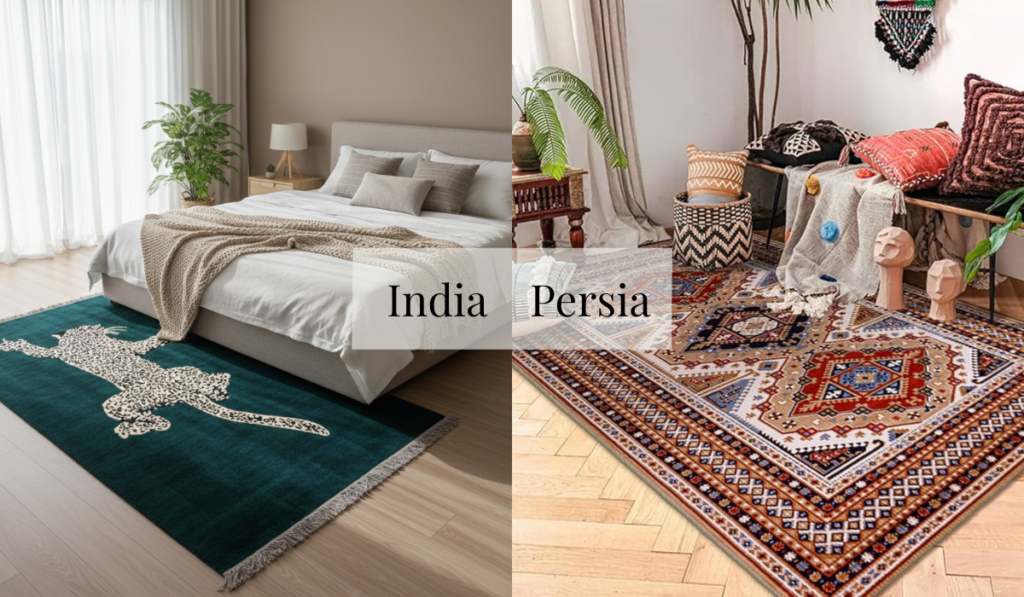
The first and most important context in any Persian rugs vs Indian rugs comparison is time. Persian rug-making is documented as far back as 500 BCE — the Pazyryk carpet, discovered in a Siberian burial mound and dated to around 500 BCE, is considered the world’s oldest surviving knotted pile rug, woven in the Persian tradition. By the time of the Safavid dynasty (1501–1736), Persian rugs had reached a level of artistic refinement that placed them among the greatest art objects ever produced anywhere in the world.
Indian rug-making began formally in the 16th century when the Mughal Emperor Akbar — himself a great admirer of Persian culture — brought master weavers from Persia to establish royal workshops at Agra, Lahore, and Fatehpur Sikri. The weavers taught their knotting techniques to Indian craftsmen, who then began blending Persian design sensibility with India’s own vibrant visual vocabulary — its lotus flowers, peacocks, elephants, and the bold jewel-toned palette of Rajasthan.
Persian Rugs
- Origin: Iran (ancient Persia)
- Heritage: 2,500+ years of documented craft
- Golden Era: Safavid dynasty, 16th–17th century
- Key Cities: Tabriz, Isfahan, Kashan, Kerman, Nain
Indian Rugs
- Origin: India (Rajasthan, Kashmir, UP)
- Heritage: 500+ years, Mughal foundation
- Golden Era: Mughal courts, 16th–18th century
- Key Cities: Jaipur, Agra, Bhadohi, Kashmir
The Connection: When comparing Persian rugs vs Indian rugs, many buyers don’t realize these two traditions share a direct parent-child relationship. Persian rugs are the ancestor. Indian rugs are the offspring that grew into its own extraordinary tradition. This shared DNA is why the two are so often confused — and why the differences are so interesting when you actually look closely.
Section 02
Persian Rugs vs Indian Rugs: Design Language & Motifs
This is often the most immediately visible difference in the Persian rugs vs Indian rugs comparison. Stand in front of both and the visual languages speak distinctly different dialects.
Persian Rug Design: Formal, Spiritual, Symbolic
Persian rug design is governed by a deep symbolic vocabulary that has been refined over centuries. The most iconic element is the toranj — the central medallion that represents the sun, divine light, or the vault of heaven. Surrounding the medallion, arabesques, palmettes, and interlocking vine scrolls create a sense of infinite, ordered beauty. The palette in classic Persian rugs tends toward deep reds, rich blues, ivory, and forest green — colours that carry symbolic meaning rooted in Persian cosmology and Islamic art.
Different Persian weaving cities have their own signature designs: Tabriz rugs feature hunting scenes and medallions; Isfahan rugs are known for their dense floral arabesque; Kashan rugs favour dark-field medallions with intricate borders; Kerman rugs use soft pastels with rose and floral sprays. Each city’s style is so distinctive that trained collectors can identify the origin of a Persian rug from the pattern alone.
Indian Rug Design: Organic, Vibrant, Regionally Expressive
Indian rugs absorbed Persian structure but added their own exuberant energy. The Mughal workshops at Agra produced rugs with naturalistic floral sprays — chrysanthemums, tuberoses, millefleurs — depicted with a botanical accuracy that Persian rugs rarely attempted. Motifs specific to Indian culture entered the repertoire: the lotus (purity), the peacock (royalty), the elephant (strength), the cypress tree (eternity).
Jaipur Indian rugs in particular are recognised for their bold, jewel-toned colour palettes — deep indigos, terracottas, saffron yellows, and forest greens reflecting the visual culture of Rajasthan’s forts and festivals. Contemporary Indian rugs from Jaipur also lead globally in geometric, abstract, and transitional designs — something Persian rugs rarely offer in the same accessible price range.
Design Style at a Glance
Persian Rug Motifs
- ◆ Toranj (central medallion)
- ◆ Arabesque vine scrolls
- ◆ Herati & boteh patterns
- ◆ Hunting & garden scenes
- ◆ Prayer (mihrab) arches
Indian Rug Motifs
- ◆ Naturalistic floral sprays
- ◆ Lotus, peacock, elephant
- ◆ Mughal millefleur fields
- ◆ Bold Rajasthani geometrics
- ◆ Abstract & contemporary
Section 03
Knotting Techniques: Persian Knot vs Indian Knot
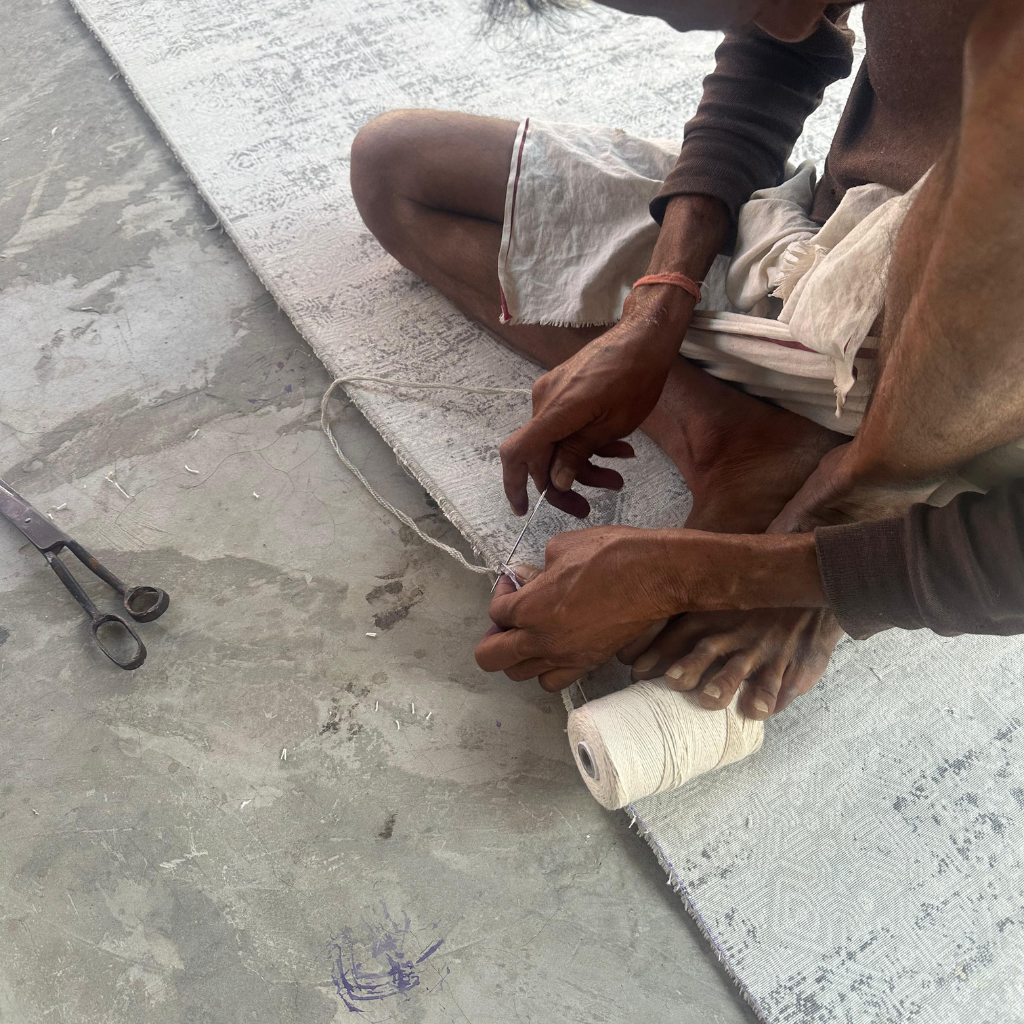
One of the most technically significant differences in Persian rugs vs Indian rugs lies at the knot level — literally. Both traditions are hand-knotted, but the type of knot used, and its implications for the finished rug, differ in important ways.
Persian (Senneh) Knot
- Also called: Asymmetric knot
- Method: Yarn loops around one warp, passes under adjacent warp
- Result: Allows finer detail; pile can lean left or right
- KPSI range: 120–840 knots per square inch
- Used in: Most fine Persian rugs, Jaipur Indian rugs
Turkish (Ghiordes) Knot
- Also called: Symmetric knot
- Method: Yarn wraps completely around both adjacent warp threads
- Result: More secure; produces a thicker, more textured pile
- KPSI range: 40–400 knots per square inch
- Used in: Turkish rugs, some Tabriz Persian rugs
In the Persian rugs vs Indian rugs comparison, both traditions primarily use the Persian (asymmetric) knot — this is part of the shared heritage. The critical difference is in knot density. The finest Persian rugs from Isfahan, Nain, and Qom can reach 600–840 KPSI, enabling a level of detail that allows weavers to reproduce photorealistic imagery in wool and silk. The finest Indian rugs from Jaipur and Kashmir also reach 400–600+ KPSI in silk pieces, but the average production quality for Indian rugs is somewhat lower KPSI than top-tier Persian — a difference that directly affects price.
Key Insight: When comparing Persian rugs vs Indian rugs by knot density, remember that KPSI is not the only quality indicator. A 150 KPSI Jaipur rug made with premium Ghazni wool and natural dyes will outlast and outperform a 200 KPSI Persian rug made with inferior materials. Always evaluate both the knot count and the material quality together.
Section 04 — Featured Snippet Ready
Persian Rugs vs Indian Rugs: Complete Side-by-Side
| Feature | Persian Rugs | Indian Rugs (Jaipur) |
|---|---|---|
| Country of Origin | Iran (Persia) | India (Rajasthan, Kashmir, UP) |
| Heritage Age | 2,500+ years | 500+ years |
| Typical KPSI | 120–840 | 80–600+ |
| Primary Knot Type | Persian (asymmetric) | Persian (asymmetric) |
| Design Style | Formal, symbolic, medallion-based | Vibrant, naturalistic, regionally expressive |
| Colour Palette | Deep reds, blues, ivory, forest green | Jewel tones, terracotta, saffron, indigo |
| Primary Materials | Fine wool, silk, cotton foundation | Wool, silk, cotton, jute |
| Price (8×10 ft) | $2,000–$50,000+ | $600–$8,000 |
| Investment Appreciation | 3–8% annually (antique pieces) | Stable; appreciates with age |
| Customization | Very limited; fixed regional styles | Fully custom — any size, colour, design |
| Availability in USA | Limited; import restrictions | Widely available; ships direct |
Section 05
Materials & Quality: What Goes Into Each
Material quality is one area where the Persian rugs vs Indian rugs comparison gets nuanced. At the premium level, both traditions use exceptional natural materials. The differences lie in sourcing traditions, dyeing heritage, and how those choices affect the rug’s appearance and longevity.
Persian Rug Materials
- Wool: Kork wool from the neck & shoulder of Persian sheep — exceptionally soft and lustrous
- Silk: Used in finest pieces; Qom silk rugs are world-renowned
- Foundation: Cotton warp and weft for stability and flat lay
- Dyes: Traditional vegetable dyes (madder, indigo, pomegranate)
- Characteristic: Colours deepen and mellow beautifully with age
Indian Rug Materials (Jaipur)
- Wool: Chokla (Rajasthani), NZ Merino, Afghan Ghazni — blended for specific properties
- Silk: Indian & Chinese mulberry silk for fine Jaipur & Kashmir pieces
- Foundation: Cotton warp/weft; jute used in some flat weaves
- Dyes: Natural vegetable & GOTS-certified chrome dyes; 3,000+ colours
- Characteristic: Vibrant colour saturation; herbal-washed finish adds lustre
One important material note for USA buyers comparing Persian rugs vs Indian rugs: the availability of authentic new Persian rugs in the US market is currently constrained by US sanctions on Iran that restrict the import of most Iranian goods, including rugs. Many “Persian rugs” sold in the US today are either antiques purchased before sanctions, or “Indo-Persian” rugs — Indian rugs made following Persian designs. This is a critical context for any current buyer.
Section 06
Price & Investment Value: The Honest Comparison
Price is often the deciding factor in the Persian rugs vs Indian rugs decision, and the gap is significant. Here is what drives it — and what it actually means for your buying decision.
Price Comparison: Persian Rugs vs Indian Rugs (8×10 ft, New)
| Quality Level | Persian Rug | Indian Rug (Jaipur) |
|---|---|---|
| Entry-level / Standard | $2,000–$5,000 | $600–$1,500 |
| Mid-range / Fine quality | $5,000–$15,000 | $1,500–$4,000 |
| Museum-grade / Silk | $15,000–$80,000+ | $3,000–$12,000 |
Why Persian Rugs Cost More
Several factors push Persian rug prices well above comparable Indian rugs. First, the finest Persian kork wool and Qom silk are among the most expensive natural fibre materials used in any rug tradition. Second, the highest KPSI levels achievable in Nain and Isfahan workshops — 600–840 KPSI — require an investment of artisan time that simply costs more. Third, and most significantly for the US market, authentic new Persian rugs are extremely scarce due to import restrictions, which has driven prices on available antique and vintage pieces sharply upward.
Investment Value: What the Data Shows
When evaluating Persian rugs vs Indian rugs as investments, the data favours Persian antiques at the top tier. Research from specialist dealers shows that museum-quality antique Persian pieces appreciate at 5–8% annually, with Isfahan silk rugs reportedly appreciating 12–15% annually over the past decade. However, this applies to the top 20% of the market — antique, authenticated, from prestigious weaving centres.
⚠ The Important Caveat: Most “Persian rugs” sold in the USA today are not investment-grade antiques. Machine-made “Persian-style” rugs have flooded the market, and even hand-knotted pieces from Pakistan or India labelled “Persian design” do not carry investment value. When comparing Persian rugs vs Indian rugs as investments, the question is: are you actually buying a genuine antique Iranian rug — or a reproduction? If the latter, a high-quality new Indian rug at a fair price is a better purchase.
Section 07
Persian Rugs vs Indian Rugs: Which One is Right for You?
After going through every key difference in the Persian rugs vs Indian rugs comparison, the answer to “which should I buy?” depends entirely on what you are trying to achieve. Here is an honest decision guide:
✓Choose a Persian Rug If…
- → You are buying an authenticated antique as an investment
- → You specifically want Iranian cultural heritage and provenance
- → You prefer deep, muted classical colour palettes
- → You collect rugs and want recognized prestige names (Tabriz, Isfahan)
- → Budget is not a constraint and access is available
✓Choose an Indian Rug If…
- → You want exceptional quality at a more accessible price point
- → You want custom size, colour, or design for your specific space
- → You love bold, vibrant, jewel-toned colour palettes
- → You want to buy direct from the manufacturer with full transparency
- → You want a new, guaranteed-authentic piece shipped to your US door
The Indo-Persian Option: There is actually a third choice in the Persian rugs vs Indian rugs debate: Indo-Persian rugs — Indian rugs crafted following traditional Persian designs (Isfahan medallions, Tabriz florals, Kashan borders). These offer Persian aesthetics at Indian prices, with full authenticity as Indian-made pieces. At Jaipur Carpet Studio, many of our most requested designs are Indo-Persian — classical in pattern, Indian in craft.
Section 08 — PAA Targeting
Frequently Asked Questions
Are Indian rugs the same as Persian rugs?
No, Indian rugs and Persian rugs are not the same — though they share a historical connection. Persian rugs originate exclusively from Iran and have a 2,500-year heritage. Indian rugs began in the 16th century when Mughal Emperor Akbar brought Persian weavers to India. Over time, Indian craftsmen developed their own distinct tradition with different motifs, colour palettes, and regional styles. Indian rugs are classified as Oriental rugs, which is the broader category that includes both Persian and Indian rugs — but Indian rugs are not Persian rugs.
Which is more expensive — Persian rugs or Indian rugs?
Persian rugs are generally more expensive than Indian rugs of comparable size. A standard 8×10 ft hand knotted Persian rug starts around $2,000 and can reach $50,000+ for fine pieces, while a comparable Indian rug from Jaipur starts around $600–1,500. The price gap is driven by knot density, material quality (especially Persian kork wool), historical prestige, and — significantly for USA buyers — scarcity due to import restrictions on Iranian goods. However, for custom designs and contemporary styles, Indian rugs offer exceptional quality at a fraction of the price.
Can I buy real Persian rugs in the USA?
Currently, US sanctions on Iran significantly restrict the import of new Persian rugs from Iran. Most genuine Persian rugs available in the US market are either antiques and vintage pieces purchased before sanctions, or rugs smuggled or misdeclared (which creates legal issues for buyers). Many rugs marketed as ‘Persian rugs’ in American stores are actually Indian, Pakistani, or Chinese rugs made in Persian design styles — which is technically accurate as a style description but not the same as an Iranian-origin rug. Always ask the seller directly: is this rug made in Iran, or is it an Indian or Pakistani rug in a Persian design?
What is an Indo-Persian rug?
An Indo-Persian rug is an Indian-made rug that follows traditional Persian design patterns — medallions, arabesques, floral fields, and borders characteristic of cities like Isfahan, Tabriz, or Kashan — but is crafted by Indian weavers using Indian materials. These rugs offer the visual aesthetic of Persian rugs at Indian price points, with full authenticity as Indian-crafted pieces. Many of the most popular Jaipur rug designs are Indo-Persian in style. They are a legitimate and excellent choice for buyers who love Persian aesthetics but want a new, custom, and more accessible piece.
Are Persian rugs better quality than Indian rugs?
At the very top tier — fine antique Isfahan or Qom silk pieces — Persian rugs represent the peak of the global rug craft. But ‘better quality’ is too broad a statement for the full comparison of Persian rugs vs Indian rugs. A high-quality Jaipur hand knotted rug at 150–200 KPSI, made with premium Afghan Ghazni wool and natural vegetable dyes, will last 100+ years and is crafted to the same fundamental standard as a good Persian rug. The gap at the mass market level is much smaller than the reputational gap suggests. And for contemporary designs, custom sizing, and accessible pricing, Indian rugs from Jaipur lead the world market.
How do I tell a Persian rug from an Indian rug?
Several visual and physical cues help identify which you are looking at. Persian rugs typically have deeper, more muted colour palettes with symbolic medallion-based designs; Indian rugs tend toward bolder, more saturated colours and naturalistic floral motifs with more organic layout. Flip the rug — both should show the pattern clearly on the reverse if hand knotted. Check for a label or certificate specifying country of origin. If buying from a dealer, ask specifically: where was this rug made, and can you provide documentation? A reputable seller of Persian rugs vs Indian rugs should have no hesitation answering this.
Jaipur’s Finest — Shipped to Your US Door
Explore Our Hand Knotted Indian Rugs — Direct from Jaipur
Whether you prefer Persian-inspired classical designs or bold Rajasthani patterns, our Jaipur workshop crafts every rug by hand using the same techniques discussed in this guide. Factory-direct pricing, full customization, and DHL Express delivery to all US states.
✓ Factory-direct from Jaipur ✓ Custom sizes & designs ✓ DHL Express to all US states ✓ Certificate of authenticity