Handmade Luxury: Direct from Jaipur Carpet Studios to Your Home

JAIPUR CARPET STUDIO
ASK THE EXPERT
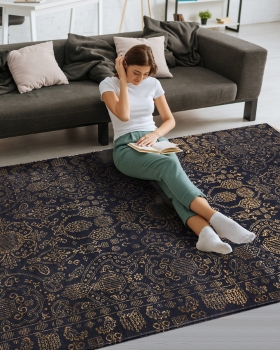
Inside Our Jaipur Workshop — Written by the Makers
How Rugs Are Made in Jaipur: A Step-by-Step Look Inside Our Workshop
Most people who own a Jaipur rug have no idea what went into making it. This is the story of how rugs are made in Jaipur — from a sack of raw Rajasthani wool to the hand-finished piece that ships to homes across the world.
By Jaipur Carpet Studio • Updated: 26 April 2026 •
“A single hand knotted rug from our Jaipur workshop passes through more than 15 pairs of skilled hands before it reaches your door. Each pair contributes something irreplaceable. This is how rugs are made in Jaipur — and why no machine has ever been able to replicate it.”
Understanding how rugs are made in Jaipur changes the way you look at the one on your floor. What appears to be a beautiful pattern is actually the result of hundreds of individual decisions made by human hands over months — choices about wool quality, dye colour, knot tension, pile height, and dozens of finishing details that collectively determine whether a rug lasts five years or five generations.
Jaipur has been a centre of rug-making for over 400 years. The city’s weaving heritage traces back to the Mughal era, when Persian master weavers were brought to Rajasthan by Emperor Akbar to teach their craft to local artisans. What emerged from that cultural exchange was a distinctly Rajasthani style — bolder colours, geometric motifs, and a regional knotting approach that became Jaipur’s signature on the world rug map.
In this guide, we walk you through every stage of the rug-making process exactly as it happens in our workshop. No marketing language. No shortcuts. Just the real story of how a Jaipur rug goes from raw wool to finished piece — and why every step matters.
Stage 01 of 08
Wool Sourcing & Sorting: It Starts in Bikaner
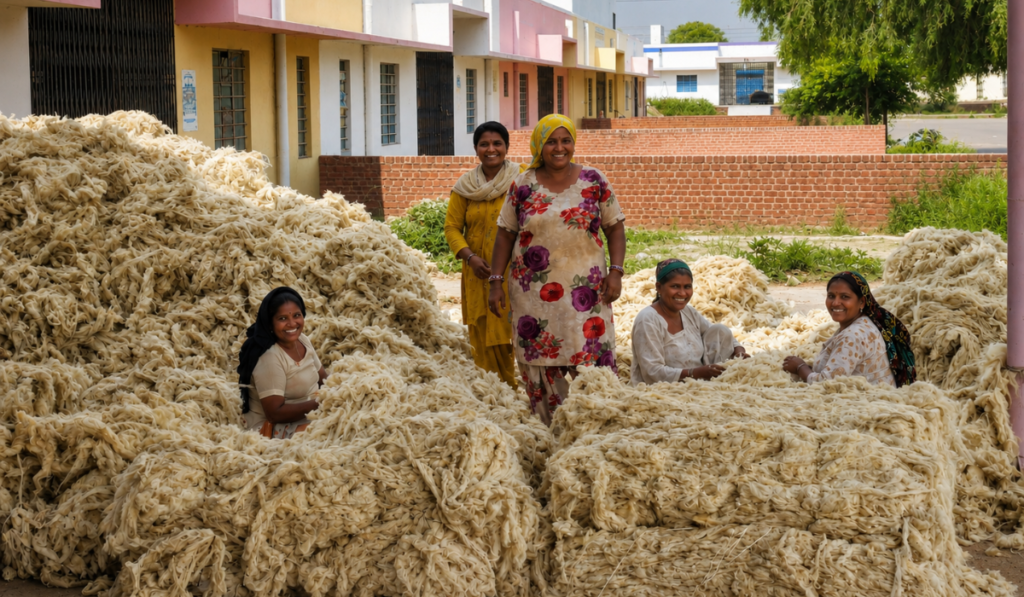
The story of how rugs are made in Jaipur begins not in a workshop, but at a livestock auction in Bikaner — a city in northwestern Rajasthan where some of India’s finest wool-producing sheep are raised. Twice a year, in spring and autumn, freshly sheared Chokla wool arrives at this market. Our team attends every auction, because selecting the right raw wool at this stage is the single most important quality decision in the entire production chain.
Chokla wool is prized for its balance of softness and tensile strength — two properties that often work against each other in other breeds. The fleece arrives in mixed lots, with varying fibre thickness and quality. Experienced sorters work through each bale by hand, separating fine fibres from coarser ones. This is not mechanized. The sensitivity required to grade wool by feel is a skill that takes years to develop.
Why Wool Quality Matters More Than Anything: A hand knotted rug with poor-quality wool will pill, shed excessively, and lose its lustre within 3–5 years regardless of how skilled the weaving is. The best Jaipur rugs start with the best wool — sorted, washed, and graded before a single thread is spun. For very fine pieces, we supplement with imported New Zealand Merino or Afghan Ghazni wool, which offer exceptional lustre and colour retention.
2x
Per year Bikaner wool auction happens — spring & autumn only
100%
Hand-sorted — no mechanical grading process can replace expert feel
3+
Sources of wool blended for premium rugs: Rajasthan, NZ Merino, Afghan Ghazni
Stage 02 of 08
Carding & Hand-Spinning: The Katwari's Art
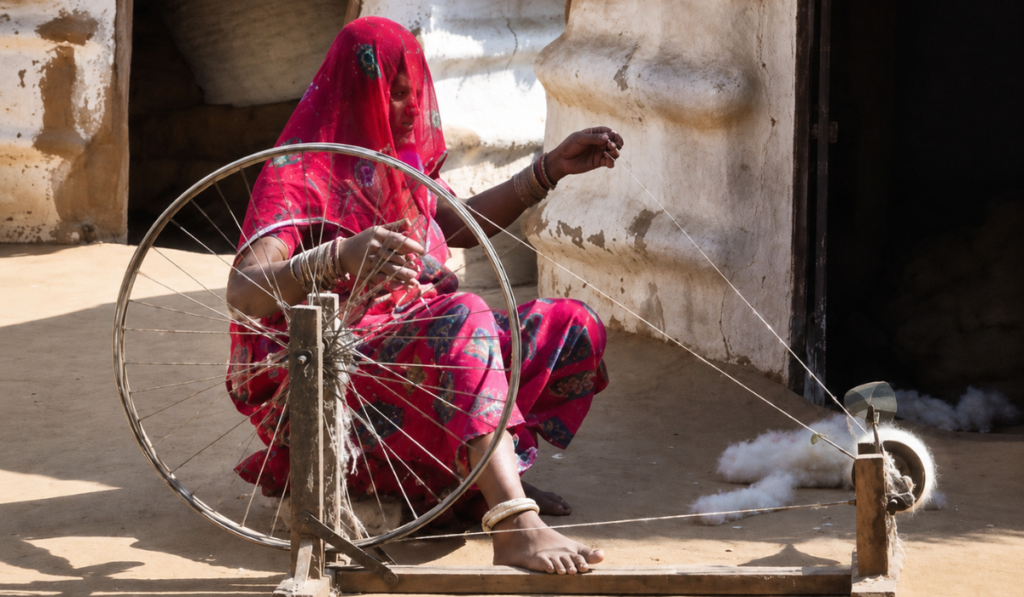
Once sorted, the wool is handed to one of India’s rarest craftspeople: the Katwari — a specialist hand-spinner whose role is disappearing as machine-spun yarn becomes more common. At Jaipur Carpet Studio, we still work with Katwaris for our finest pieces because the difference between hand-spun and machine-spun yarn is not just philosophical. It is physical and visible in the finished rug.
The process begins with carding — the Katwari places raw wool on a bristled pad and works it with a second pad in sweeping strokes, separating and aligning the fibres. Clumped dirt, short fibres, and any remaining impurities are removed in this stage. The result is a soft, cloud-like batt of aligned wool ready for spinning.
The spinning itself is done on a charka — the traditional Indian spinning wheel that Gandhi made a national symbol. The Katwari draws the carded wool and feeds it onto the spindle with practiced tension, twisting the fibres into a continuous strand. The resulting hand-spun yarn has a characteristic irregularity — slightly thicker here, slightly thinner there — that gives hand knotted Jaipur rugs the subtle variation in pile height that distinguishes them from machine-uniform products.
The Abrash Effect: That subtle colour variation you see when light hits a hand knotted rug from different angles? It’s called abrash, and it happens because hand-spun yarn absorbs dye slightly differently in each batch. Machine-made rugs lack this entirely. In the antique rug market, abrash is considered a mark of authenticity and is actively sought by collectors.
Stage 03 of 08
Dyeing the Yarn: Where Colour Meets Chemistry
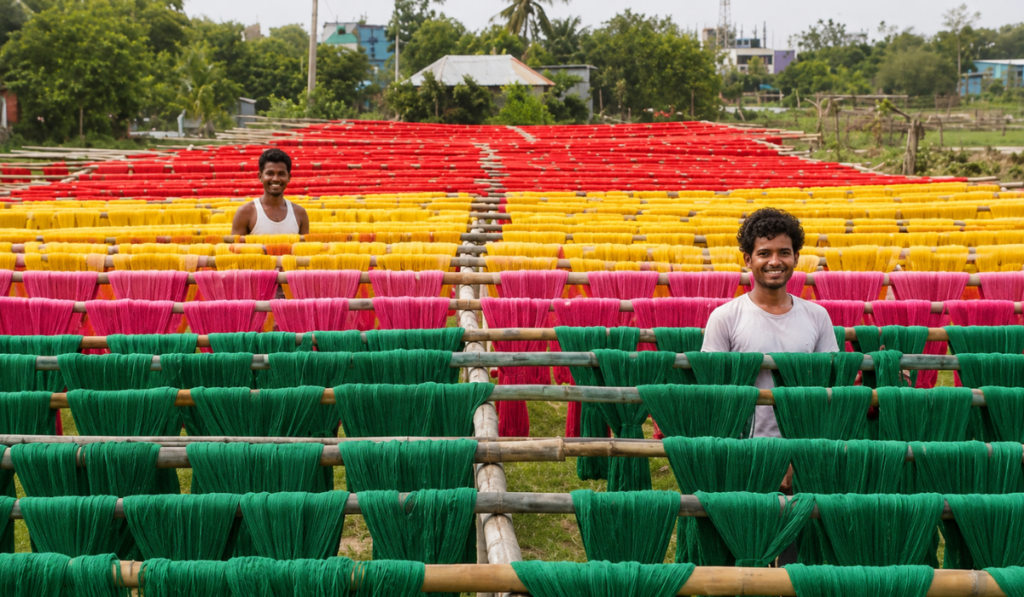
The dyeing stage is where the colour story of a Jaipur rug is written. It is also one of the most skill-intensive parts of how rugs are made in Jaipur, because a colour that looks beautiful on a small yarn sample can appear completely different when woven into a full-sized rug under different lighting conditions.
The process begins with segregation. Lighter wool is paired with lighter dye lots; darker wool absorbs richer, more saturated colours. The yarn is wound onto a circular frame and submerged in large vats of boiling dye. The heat and duration of the dip determine how deeply the colour penetrates the fibre — and this depth determines how well the colour holds over decades of use.
🌿 Natural / Vegetable Dyes
- Sources: Indigo, pomegranate rind, madder root, turmeric, henna
- Ageing: Mellows beautifully over decades into rich patina
- Environmental: Biodegradable, no toxic runoff
- Best for: Traditional, antique-style, and heirloom pieces
⚗ Premium Chrome / GOTS Dyes
- Certification: GOTS-certified, eco-friendly, no heavy metals
- Colour range: 3,000+ shades, fully customizable for any project
- Colorfastness: Excellent — does not bleed or fade with washing
- Best for: Contemporary, custom, and colour-matched projects
After dyeing, the yarn skeins are hung outdoors under the Rajasthan sun to dry naturally. This outdoor drying process takes several hours and continues to set the dye through controlled UV exposure. Once dry, the yarn is stored by colour lot until it reaches the design and warping stages.
Stage 04 of 08
Design & the Naksha: Every Knot is Planned
Before a single knot is tied, the entire rug must be designed and translated into a format that weavers can follow knot-by-knot. This document is called the naksha — a gridded colour-coded map of the rug where every square represents a single knot and its colour.
Traditionally, naksha designs were hand-painted on graph paper by specialist designers. Today, computer-aided design (CAD) tools allow for much greater precision and faster iteration — especially for custom orders where a client needs to see and approve a design before production begins. However, even with digital tools, creating a quality naksha for a fine rug with 200+ KPSI is a process that takes experienced designers several days to complete.
How the Naksha Works in Practice
The design is finalized and converted into a grid — one cell per knot. A 9×12 ft rug at 150 KPSI produces a grid with approximately 1.7 million individual squares.
Each cell is assigned a colour code that corresponds to a specific dyed yarn lot. A complex traditional design can use 20–30 different colours.
A talim reader (design caller) sits beside the weavers and reads out the colour sequence row by row. For complex patterns, this caller and weaver work as one synchronized unit.
Quality checkers verify the knot count against the naksha at regular intervals during production — catching errors before they become irreversible sections of completed weaving.
For custom orders from our USA clients, this is the stage at which you review and approve the design digitally. We can render a photorealistic preview showing how your specific colour choices will appear in the finished rug before production begins.
Stage 05 of 08
Loom Setup & Warping: Building the Foundation
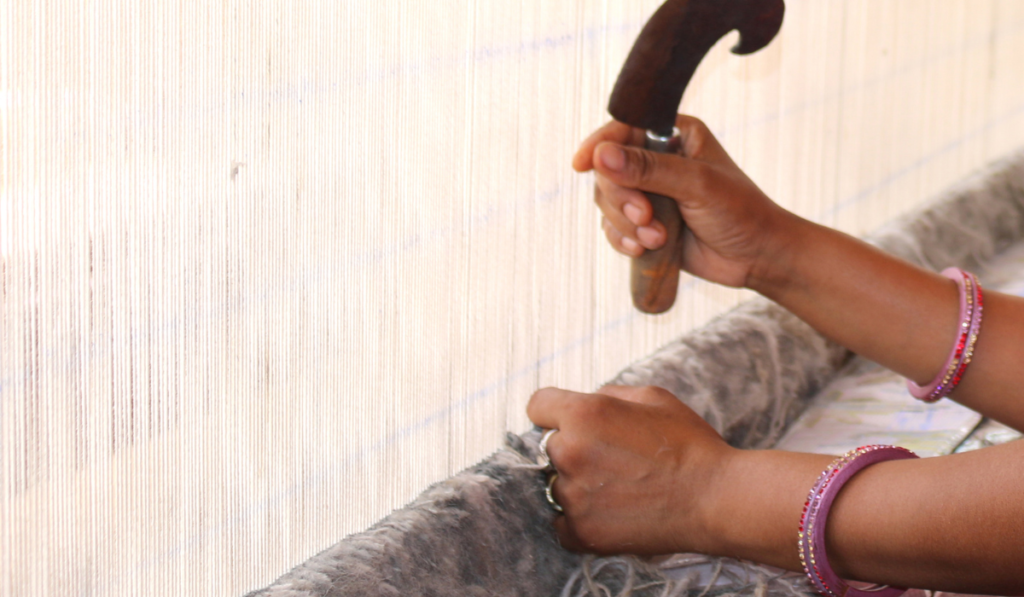
Understanding how rugs are made in Jaipur requires understanding the loom — because the loom is not just a tool, it is the structural frame that determines the rug’s final dimensions, the tension of every knot, and the density of the pile.
Jaipur hand knotted rugs are woven on vertical pit looms or frame looms. The setup begins with warping — stretching strong cotton or linen threads vertically from top to bottom across the loom frame. These vertical threads are the warp, and they form the structural skeleton of the finished rug. Warp threads are never seen in the finished piece, but everything depends on their even tension.
Types of Looms Used in Jaipur
〈 Vertical Pit Loom
Most traditional type. Weavers sit on a plank that rises as the rug grows. Used for large format rugs up to 20×30 ft. Common in village workshops.
〈 Frame Loom
Fixed frame that does not require a pit. Used in our main workshop for standard sizes. Allows better lighting and quality inspection during weaving.
Once the warp is set, the loom is checked for even tension across every thread. Uneven tension at this stage leads to a warped rug off the loom — one of the most common quality problems in cheaper production. A correctly warped loom is the non-negotiable foundation for a rug that lies flat, measures true to its ordered dimensions, and maintains its shape for decades.
Stage 06 of 08 — The Heart of the Process
Hand Knotting: Where Skill Meets Time
This is the stage that defines how rugs are made in Jaipur — and why they cannot be duplicated by machine. The weaver sits at the loom with the naksha (design map) visible, a set of colour-coded yarn bundles arranged within reach, and a hook knife — the weaver’s primary tool — in hand.
Each knot is tied individually around a pair of adjacent warp threads. The most common knot used in Jaipur is the asymmetrical Persian knot (Senneh knot), which allows for finer detail on one side of the design. After each row of knots is complete, a weft thread is passed horizontally through the warp — locking the row in place — and a comb beater is used to pack the knots down tightly. The surplus yarn tails above the knots form the pile of the rug.
10,000
Knots per day — average output of a skilled Jaipur weaver
240
Working days for one weaver to complete an average 8×10 ft rug
600+
KPSI possible in our finest Jaipur silk pieces — luxury-grade density
KPSI: The Measure of a Rug’s Quality
| KPSI Range | Grade | Typical Use |
|---|---|---|
| 40–80 KPSI | Entry-level | Simple geometrics, large patterns |
| 100–200 KPSI | Standard quality | Most residential hand knotted rugs |
| 200–400 KPSI | Fine quality | Detailed florals, intricate medallions |
| 400–700+ KPSI | Museum grade | Silk rugs, collector pieces, prestige commissions |
Stage 07 of 08 — The Final Transformation
The 18 Finishing Steps: What Happens After Weaving
Many people assume that once the weaving is complete, the rug is ready to ship. In reality, a Jaipur hand knotted rug undergoes 18 distinct finishing steps after it comes off the loom — a process that can take an additional two to four weeks when done entirely by hand. These steps are not optional polish; they are essential to the rug’s final appearance, dimensions, and structural integrity.
Size Measurement
Rug is measured; any variation from ordered dimensions is noted for correction
Knot Counting
Every row is counted against the naksha to verify no knots are missing
Pile Height Check
Pile is measured to ensure consistent height across the entire surface
Raffu (Repair)
Specialist “rug doctors” surgically repair any missing or incorrect knots with needle and thread
Design Correction
Tangled yarns are separated and design lines clarified using a large needle
Back-Burning
Controlled flame passed over the back of the rug to singe loose strands and tighten knots
Washing
Full wash with water and mild cleansing solution enriches lustre and reveals final colour depth
Khinchai (Stretching)
Post-wash stretching on an iron frame balances tension and locks the rug to its final dimensions
Sun Drying
Natural drying in Rajasthan sun — UV exposure helps further set dye and kill any residual bacteria
Primary Shearing
Electric or hand shears even the pile to the specified height — first pass
Khadi Gultarash (Carving)
Scissors held upright make precise cuts along design lines, sharpening each motif’s edge
Put Gultarash (Embossing)
Angled scissors create high-and-low pile effect, giving the rug its three-dimensional sculptural look
Edge Binding
Edges bound by hand in a matching or contrasting colour — structural and aesthetic step
Thread Cleaning
Artisan brushes through entire pile removing any remaining loose thread ends
Final Shearing
Second precision shearing pass sets exact final pile height and smooths entire surface
Pattern Alignment
Knots along warped areas are tapped into alignment using nail and hammer — straightens design lines
Final Quality Inspection
Entire rug reviewed in bright light from multiple angles — colour, pile, edges, fringe, and dimensions verified
Certificate & Tagging
Certificate of authenticity attached specifying KPSI, materials, dye type, and weaver details
Important for buyers: When 18 finishing steps are all done by hand, the process alone takes 3–4 weeks. A rug that completes these steps properly will lie flat, measure true to its ordered size, and have a pile that is even, clean, and correctly embossed. A rug that skips finishing shortcuts becomes visible within months — pilling, uneven pile, and edges that curl or fray.
Stage 08 of 08
Final Quality Check & Export to the USA
The final stage of how rugs are made in Jaipur is the one that connects our workshop directly to your living room. Before any rug leaves our premises, it goes through a final senior-level inspection — photographed in natural light at full resolution from the front, back, and both side angles. This documentation travels with the rug and is available to the buyer on request.
For USA customers, we roll the rug around a protective cardboard tube, wrap it in dense poly-foam, seal it in a heavy-duty waterproof outer bag, and hand it to DHL Express for international shipping. The accompanying documentation includes the Commercial Invoice, Packing List, Certificate of Origin, and our own Certificate of Authenticity specifying the construction type, pile material, knot density, dye method, and the approximate number of artisan hours invested.
Total Journey: From Wool to Your Door
In-Stock Rug
Finishing + inspection + packaging: 5–7 days. DHL delivery to USA: 7–10 business days. Total: ~2–3 weeks
Custom Hand Knotted
Wool sourcing + dyeing + weaving + 18 finishing steps: 4–12 months. Worth every day.
For Interior Designers & USA Buyers: Because we are the manufacturer, not a trader, we can give you real-time production updates at every stage of a custom order — including photos from the loom during weaving. This transparency is something retail or wholesale channels simply cannot offer. Contact us to discuss your project.
The People Behind Every Jaipur Rug
When you understand how rugs are made in Jaipur, you quickly realize that the process is inseparable from the people. A single hand knotted rug passes through the hands of over 15 skilled specialists — wool sorters, Katwari spinners, dyers, naksha designers, loom setters, master weavers, raffu repair artisans, finishing specialists, quality inspectors, and packagers. Each one contributes a skill that the others cannot replicate.
15+
Specialist hands that touch every hand knotted rug we produce
400+
Years of unbroken rug-making heritage in Jaipur, Rajasthan
3 Gen
Our family has been making and exporting Jaipur rugs for three generations
Many of the artisans we work with learned from their parents, who learned from their grandparents. The knowledge is embodied — it lives in hands and muscle memory, not in manuals. India’s Carpet Export Promotion Council recognises Jaipur as one of the country’s premier rug-making regions precisely because this generational continuity of craft still exists here. When you buy a Jaipur rug, you are not just buying a floor covering. You are buying a document of time and skill.
PAA Targeting — Frequently Asked Questions
Frequently Asked Questions
How long does it take to make a hand knotted rug in Jaipur?
It depends on the size and knot density. A standard 8×10 ft hand knotted wool rug at 150 KPSI takes one skilled weaver approximately 240 working days to complete alone — or about 2–3 months when a team of 3–4 weavers work simultaneously. Add 3–4 weeks for the 18 finishing steps, and the total production time is typically 3–6 months for a standard rug. Finer pieces at higher KPSI, or larger sizes, can take 12–24 months. Hand tufted and flat weave rugs made in Jaipur are completed much faster — typically 2–6 weeks from start to finish.
What makes Jaipur rugs different from other Indian rugs?
Jaipur rugs are known for several distinctive characteristics: bold Rajasthani colour palettes often inspired by the region’s forts, palaces, and desert landscape; the use of the asymmetrical Persian knot which allows for fine detail; a tradition of using both natural vegetable dyes and premium chrome dyes; and a 400-year unbroken heritage of multi-generational weaving communities. Compared to rugs from Bhadohi (which tend toward Persian-style patterns) or Kashmir (known for ultra-fine silk work), Jaipur rugs have a distinctive visual energy and regional character that collectors and interior designers specifically seek.
What materials are used to make rugs in Jaipur?
The most common pile material is wool — typically sourced from Rajasthani Chokla sheep, supplemented with New Zealand Merino or Afghan Ghazni wool for premium pieces. Silk, both Indian and imported Chinese mulberry silk, is used for fine decorative rugs. The foundation (warp and weft threads that hold the structure together) is almost always cotton for its strength and dimensional stability. Flat weave rugs use wool, cotton, and sometimes jute. Dyes are either natural vegetable-based (indigo, madder, pomegranate) or GOTS-certified chrome dyes with over 3,000 available shades.
How do I know if a Jaipur rug is genuinely handmade?
The most reliable test is to flip the rug over. On a genuine hand knotted rug, the pattern is clearly visible on the reverse side — you can see individual knot tails creating a slightly textured mirror image of the front design. The reverse of a hand tufted rug shows only canvas and glued fabric backing — no pattern. For fringe: on a hand knotted rug, the fringe is a natural extension of the warp threads and is structurally part of the rug. On a hand tufted rug, fringe is sewn on separately. Additionally, request a Certificate of Authenticity from the manufacturer specifying construction type, KPSI, materials, and dye method.
Can I visit the Jaipur Carpet Studio workshop?
Yes — we welcome visits from serious buyers, interior designers, and anyone genuinely curious about how rugs are made in Jaipur. Seeing the loom in person, watching a weaver tie knots, and understanding the finishing process firsthand changes how you think about every rug you own. Contact us in advance to schedule a visit to our Jaipur workshop. We can arrange a full behind-the-scenes tour, including the dyeing facility, loom floor, and finishing centre.
How are Jaipur rugs different from machine-made rugs?
The differences are fundamental, not cosmetic. A machine-made rug is produced in hours on a power loom; a hand knotted Jaipur rug takes months or years. Machine rugs have perfectly uniform pile — which actually makes them look flat and lifeless under directional light. Hand knotted rugs have slight natural variation in pile height (called abrash) that creates depth and visual richness. Structurally, machine rugs use synthetic or bonded backings that fail within years; hand knotted rugs are one integrated structure that strengthens with age. And simply: machine rugs cannot be repaired — hand knotted rugs can be restored to full beauty by skilled craftspeople at any point in their lives.
See It for Yourself — From Our Loom to Your Home
Own a Rug Made the Way Jaipur Has Always Made Them
Every rug in our collection goes through every stage described in this guide — no shortcuts, no substitutions. We are the manufacturer. We know every hand that touched the rug before it reaches yours. DHL Express to all US states. Certificate of authenticity included.
✓ Factory-direct from our Jaipur workshop ✓ Custom sizes & designs ✓ DHL Express worldwide ✓ Certificate of authenticity