Handmade Luxury: Direct from Jaipur Carpet Studios to Your Home
Rug Buying Guide — Size & Fit 2026
A room-by-room rug sizes guide with a full standard size chart — so you choose a rug that fits your space the first time, not the third.
By Jaipur Carpet Studio • Updated: 28 MAY 2026
"A rug that is one size too small can make an entire room feel unfinished — the right size makes the same furniture look intentional, grounded and complete."
Getting the dimensions right is the single most important decision you will make when buying a floor covering, which is exactly why this rug sizes guide exists. The most common and most visible mistake in any room is a rug that is too small — it floats in the middle of the floor, disconnects the furniture, and shrinks the space instead of anchoring it.
The trouble is that there is no single “correct” size. The right rug depends on the room, the furniture layout, and how you want the space to feel. An 8×10 that is perfect in a compact living room can look lost in an open-plan one, and a runner that suits a narrow hallway will overwhelm a galley kitchen.
At Jaipur Carpet Studio we have crafted hand-knotted rugs for homes across the world for decades, and we size every custom piece to the room it is destined for. Below we break down the ideal rug sizes room by room, share a complete standard size chart, and show you how to measure your own space — including when a custom size is the smarter choice.
Section 01
If you remember one rule from this rug sizes guide, make it this: when in doubt, go bigger. A generously sized rug pulls the furniture together into a single visual group and leaves a tidy, balanced border of bare floor around the edge of the room. A small rug does the opposite — it breaks the room into fragments.
The practical target is to leave a consistent margin of exposed floor between the edge of the rug and the walls. In most rooms, 18 inches of bare floor on each side is ideal; in smaller rooms, 8 to 12 inches still reads as deliberate. What you want to avoid is a rug that stops awkwardly under the front of the sofa with nothing beneath your feet.
The three rules that never fail
1. All the main furniture, or at least the front legs, should sit on the rug.
2. Leave an even border of floor on all sides — symmetry is what looks luxurious.
3. If a standard size lands between two options, choose the larger one.
Section 02
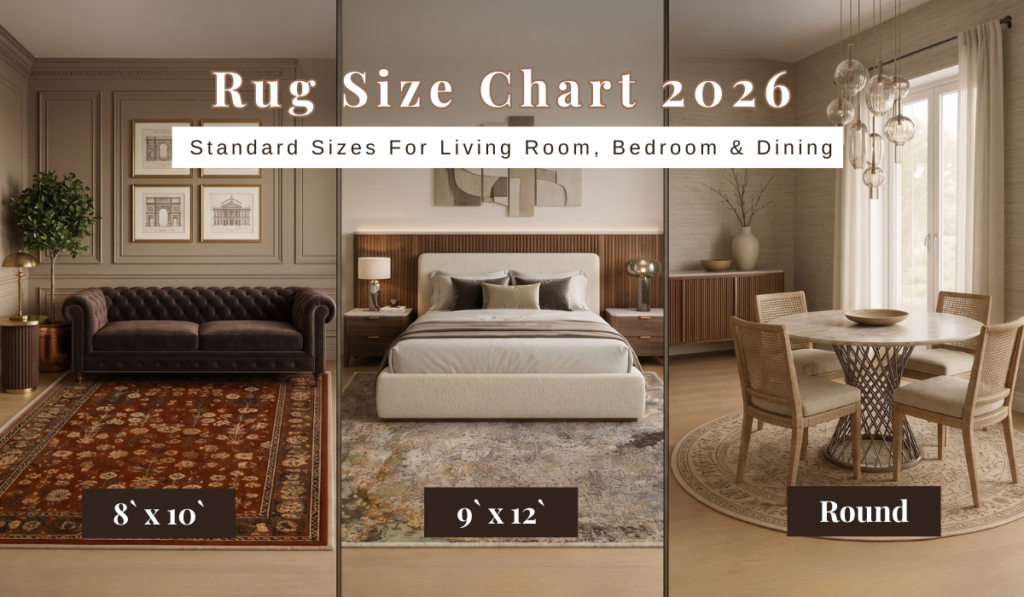
The living room is where rug size matters most, so it is where most people start with a rug sizes guide. It is usually the largest seating area in the home, and the two workhorse sizes are 8×10 and 9×12 feet. An 8×10 suits most standard living rooms and comfortably holds a sofa and a pair of chairs around a coffee table.
For an open-plan or larger living room, step up to a 9×12 or even 10×14 so that all four legs of every piece of furniture rest on the rug. This is the most premium look: the seating sits fully “inside” the rug rather than perched on its edge.
If your budget or layout calls for a smaller rug, the acceptable compromise is to place only the front legs of the sofa and chairs on the rug — this still ties the grouping together. Anything smaller, where the rug sits island-like under just the coffee table, is the arrangement we steer clients away from. Explore options in our full rug collection.
Section 03
In the bedroom, the rug should frame the bed and give you something soft to step onto in the morning. The rule of thumb is to choose a rug that extends 18 to 24 inches beyond both sides and the foot of the bed, with the rug tucked roughly one-third of the way under the mattress (starting just below the nightstands).
For a queen bed, an 8×10 rug is the sweet spot. For a king bed, go up to a 9×12 to keep that generous border on both sides. With a twin or in a child’s room, a 5×8 placed under the lower two-thirds of the bed works well.
Short on budget for a single large rug? Two runners (around 2.5×8) placed on either side of the bed, or a smaller rug angled across the foot of the bed, are both elegant alternatives that still deliver warmth underfoot where you actually stand.
Section 04
The dining room is the section of any rug sizes guide people get wrong most often. There is one non-negotiable rule: the rug must be large enough that the chairs stay on the rug even when pulled out. Nothing is more frustrating than a back chair leg catching the rug edge every time someone sits down. To get this right, add at least 24 inches (ideally 30) to every side of your table’s footprint.
As a quick reference: a four-seat table works on a 5×8 or 6×9; a six-seat table needs an 8×10; and a table for eight or more looks best on a 9×12 or larger. Round tables pair beautifully with round rugs — match the rug diameter to the table size plus four feet.
Because dining rugs see spills and heavy chair traffic, a tightly hand-knotted wool rug is the practical choice here — it is dense, durable and easy to spot-clean. If you would like a size that is not standard, a custom rug order lets you match the rug exactly to your table.
Section 05
Use this at-a-glance area rug size chart to match a standard size to your room before you measure. It is the quick-reference heart of this rug sizes guide: these are the dimensions stocked most widely, so they are the easiest to find and the most economical to buy.
| Rug Size | Best For | Room Type |
|---|---|---|
| 2×3 / 3×5 ft | Doorways, kitchen sink, small entry | Entryway |
| 4×6 ft | Reading nook, small bedroom accent, under a cot | Accent |
| 5×8 ft | Small living room, 4-seat dining, twin bed | Living / Dining |
| 6×9 ft | Compact lounge, 4-6 seat dining table | Living / Dining |
| 8×10 ft | Standard living room, queen bed, 6-seat dining | Living / Bedroom |
| 9×12 ft | Large living room, king bed, 8-seat dining | Living / Bedroom |
| 10×14 ft | Open-plan living, grand dining room | Open-plan |
| Runner 2.5×8 ft | Hallways, bedside, galley kitchen | Hallway |
| Round 6 or 8 ft | Round dining table, entryway, nursery | Dining / Entry |
Note: 1 foot ≈ 30 cm. The most popular all-round sizes are 8×10 and 9×12 — when unsure, these two cover the majority of rooms.
Section 06
No rug sizes guide is complete without runners. Long, narrow spaces call for runner rugs. The most useful runner widths are 2.5 to 3 feet, which leave a neat 4 to 6 inches of floor showing on each side of a standard hallway. Common lengths run from 2×8 up to 3×14, and you can layer two runners end to end for an extra-long corridor.
In an entryway, scale the rug to the space: a 2×3 or 3×5 suits a modest front door, while a wider foyer can carry a 4×6 or a round rug to soften a square landing. Leave a few inches of clearance so the door swings freely over the pile.
Runners also shine beside a bed, along a galley kitchen, and up a staircase. Because these are high-traffic zones, a hard-wearing hand-knotted wool runner will hold its shape and colour far longer than a machine-made alternative.
Section 07
Measuring is simple and worth doing properly. Clear the room mentally to the furniture layout you want, then mark the rug’s outline on the floor with painter’s tape. Stand back, check the border on all four sides, and adjust until it looks balanced. Measure the taped rectangle — that is your size.
Always measure the furniture footprint plus the border you want, not just the empty floor. For seating, account for the front legs landing on the rug; for dining, add 24 to 30 inches around the table; for beds, add 18 to 24 inches on the exposed sides.
When your room falls between standard sizes — an awkward alcove, an oversized open-plan space, or a non-rectangular room — a custom rug is the right call. Because every Jaipur Carpet Studio rug is hand-knotted to order, we can match almost any dimension, shape and colour. Tell us your measurements and we will craft a piece that fits as if the room were built around it. Start a custom rug order with our team.
No fibre, colour or pattern can rescue a rug that is the wrong size. If this rug sizes guide leaves you with one habit, let it be measuring first — get the dimensions right and almost any quality rug will make the room feel complete.
Living room — 8×10 or 9×12
Queen bedroom — 8×10
King bedroom — 9×12
Dining (6 seats) — 8×10
Hallway — 2.5×8 runner
When in doubt, size up. Keep an even border of bare floor. Get the furniture (or its front legs) onto the rug. And if your room sits between sizes, a custom rug always wins.
Section 08
You have the full rug sizes guide — now let us put it to work. Tell us your room and measurements, and our Jaipur artisans will hand-knot a rug sized exactly for your space, in the colours and pattern you love.
Factory-direct pricing • Custom sizes • Worldwide shipping • Certificate of authenticity